
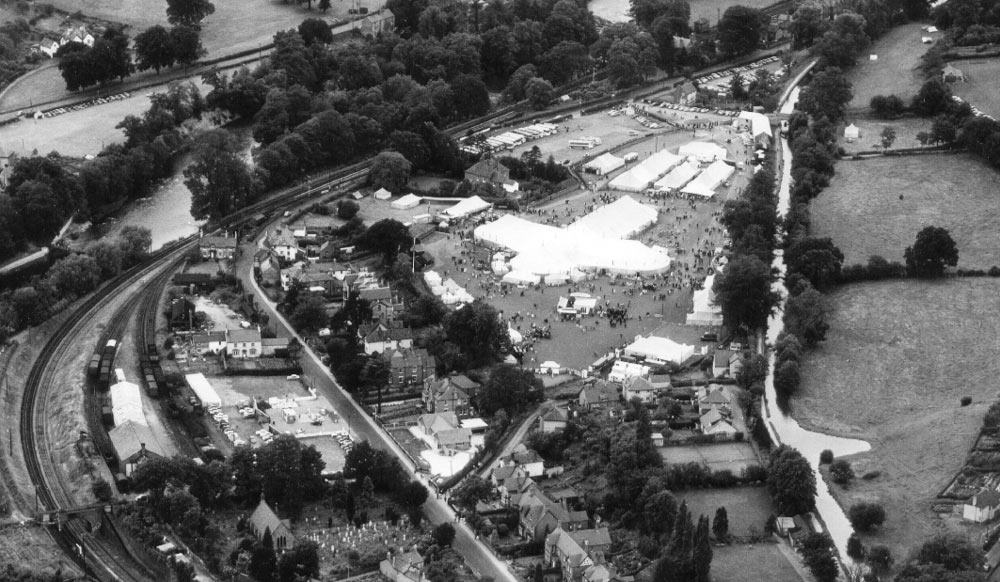
The Eisteddfod has a long and fascinating history, going back at least eight centuries. Llangollen has very close connections with the eisteddfodic tradition in Wales, not only with the establishment of the International Eisteddfod but also with the history and development of the National Eisteddfod.
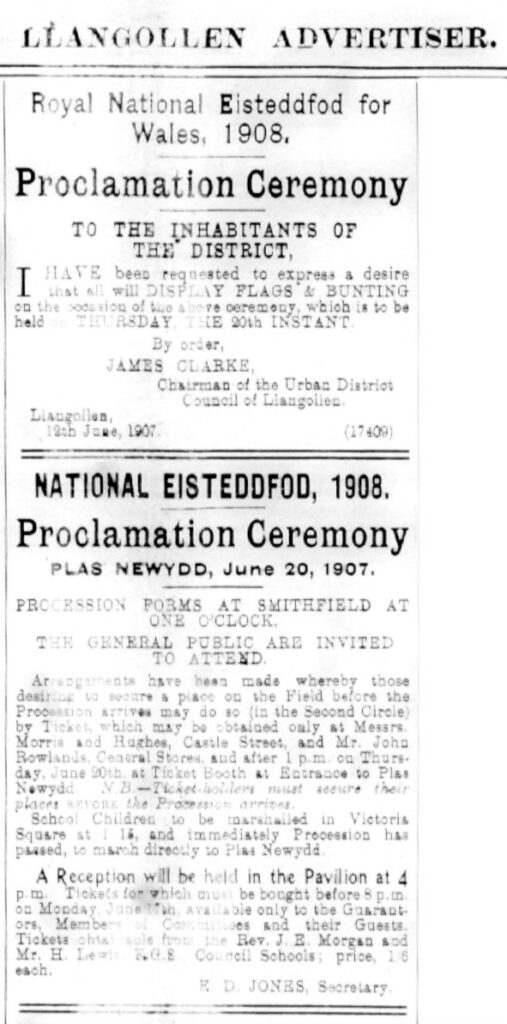
Advert for the National Eisteddfod in Llangollen in 1908.
The Llangollen Eisteddfod of 1858 was one of the strangest and yet most important eisteddfodau in history. This was the first eisteddfod to be organised on such a large scale, hence the name “Eisteddfod Fawr Llangollen “ (Great Llangollen Eisteddfod). It was advertised in Welsh and English papers and magazines and also in the USA!
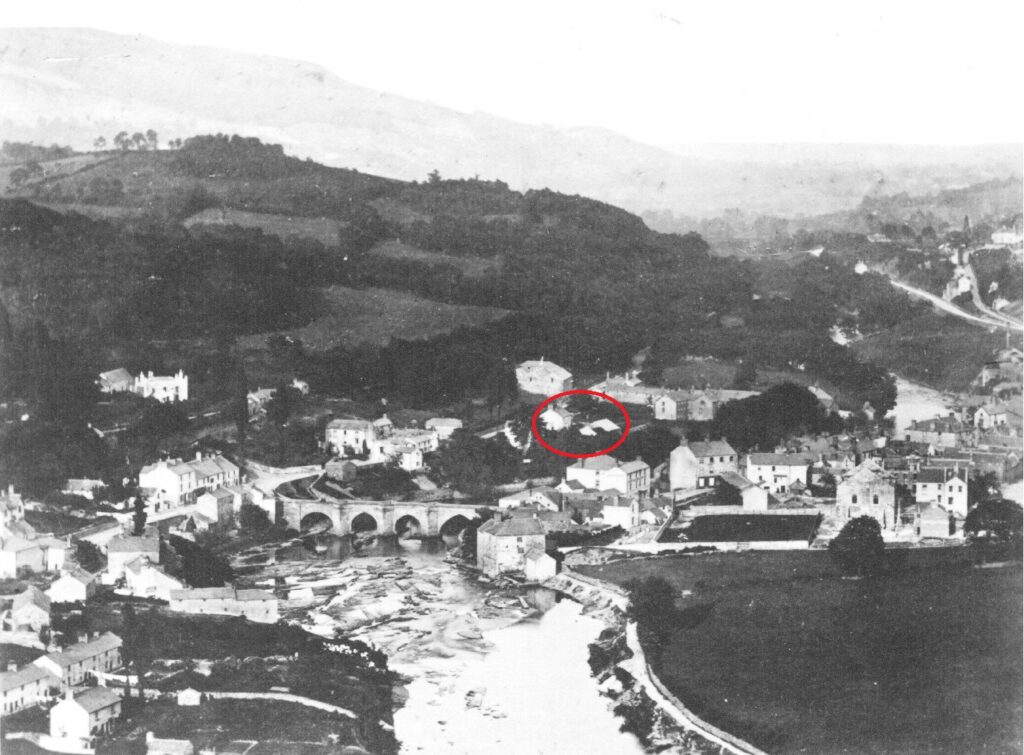
Llangollen at the time of the Eisteddfod Fawr. The Ponsonby Arms, with a tent in the grounds, is highlighted in red.
Many came on foot, one of whom recalled: “ As we were nearing Llangollen, we were met with the bad news that the town was crammed and that beds were a guinea a night.” Another related “ When we reached Llangollen the whole town came out to meet us.”
A pavilion of some sort was needed to house the activities of the four days, so a tent was erected on land next to the Ponsonby Arms. It held 5,000 people. The weather was not kind: “It turned into a terrible storm on Wednesday and Thursday……..wild and fierce lightning…darted through the air.”
The tent did not do its job very well: “heavy rain was experienced, and the canvas roof was no protection, water lodging there and continuing to rush through long after the showers had subsided. With umbrellas open, and cries of ‘sit down in the front’, nothing could be heard from the stage.”
Criticism of the Eisteddfod was aimed from many directions and for various reasons. It was harshly criticised for being organised totally by Anglican clerics. Another complaint was that one of the organisers – the Rev. John Williams (ab Ithel) and his family had won many of the prizes! Despite these comments, there was much praise for the Great Llangollen Eisteddfod of 1858. One eye-witness stated: “I never witnessed a better attempt at carrying out the Eisteddfod on its proper national basis.” Another summed it up succinctly: “ ..an excellent Eisteddfod, -a large, lively one.”
‘Myfanwy’ by John Hughes (Ceiriog) won the prize for the best love song at the Great Llangollen Eisteddfod of 1858.
The end of the activities and competitions was not the end of the influence of the Great Llangollen Eisteddfod, however. From one of the meetings connected with it came a proposal to establish a committee to consider organising a truly National Eisteddfod.
It was agreed to hold a National Eisteddfod annually in North and South Wales alternately and, occasionally, in England. The National Eisteddfod visited Llangollen again in 1908, when both David Lloyd George and Winston Churchill attended.

Lloyd George and Winston Churchill at the 1908 National Eisteddfod in Llangollen.
However, Llangollen is primarily known today for the Llangollen International Musical Eisteddfod.
In the bleak years following the 1939-1945 war, one of the world’s most important musical festivals was established in Llangollen. Harold Tudor, a journalist for the British Council and a native of Coedpoeth, had been responsible for introducing many foreign dignitaries to Welsh culture by organising visits to eisteddfodau. In his booklet ‘Making the Nations Sing’ he describes hearing a boy singing a Welsh hymn as he walked in a country lane near Coedpoeth. This seemingly trivial incident inspired him to try to establish an international event. For personal, sentimental reasons Mr Tudor approached the townspeople of Llangollen with the idea. It gained support at once.
W.S. Gwynn Williams, a music publisher and Pencerdd of the Gorsedd of the National Eisteddfod, was the leading supporter in Llangollen. He became the new Eisteddfod’s Musical Director from 1947 until his death in 1978 and, throughout these years, he was the major figure in the organisation of the annual Eisteddfod. It was said of him in 1971: “Welshmen may not yet have realised how influential Gwynn Williams has been……in less than a quarter of a century he has played an important role in the development of music making in Wales.”
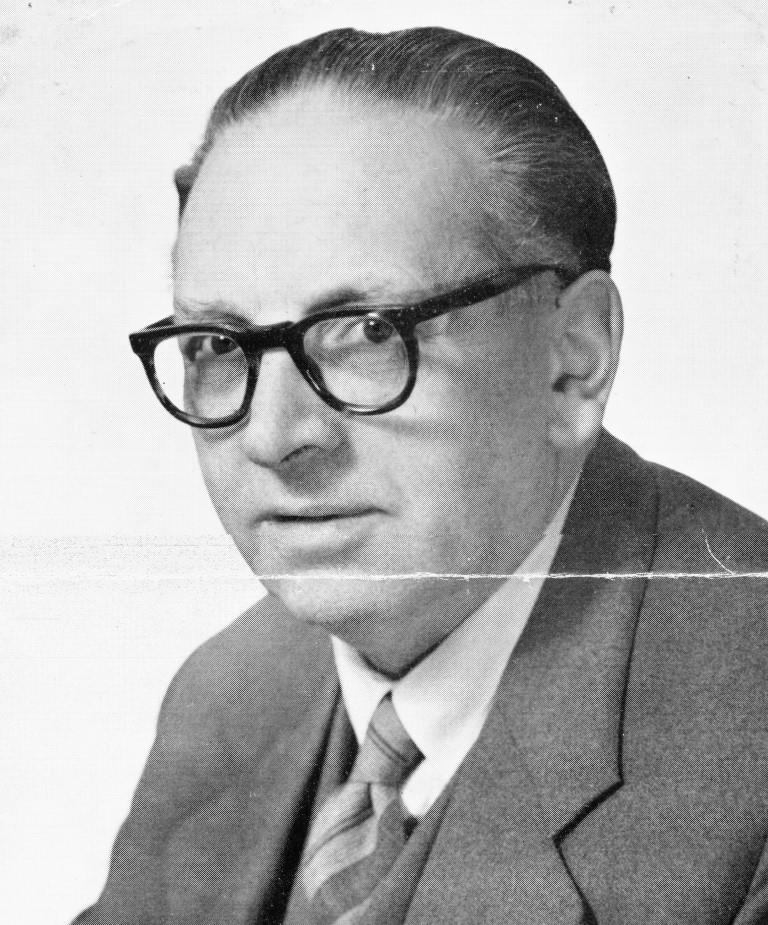
W.S. Gwynn Williams
The Eisteddfod, today, is still going strongly with more than 6,000 competitors from about fifty different countries taking part in competitions for male, female, mixed and youth choirs. In addition there are colourful competitions for dance groups and folk song parties. The Eisteddfod is almost entirely run by volunteers and about 400 committee members from the Llangollen area are busy throughout the year ensuring the success of the festival.
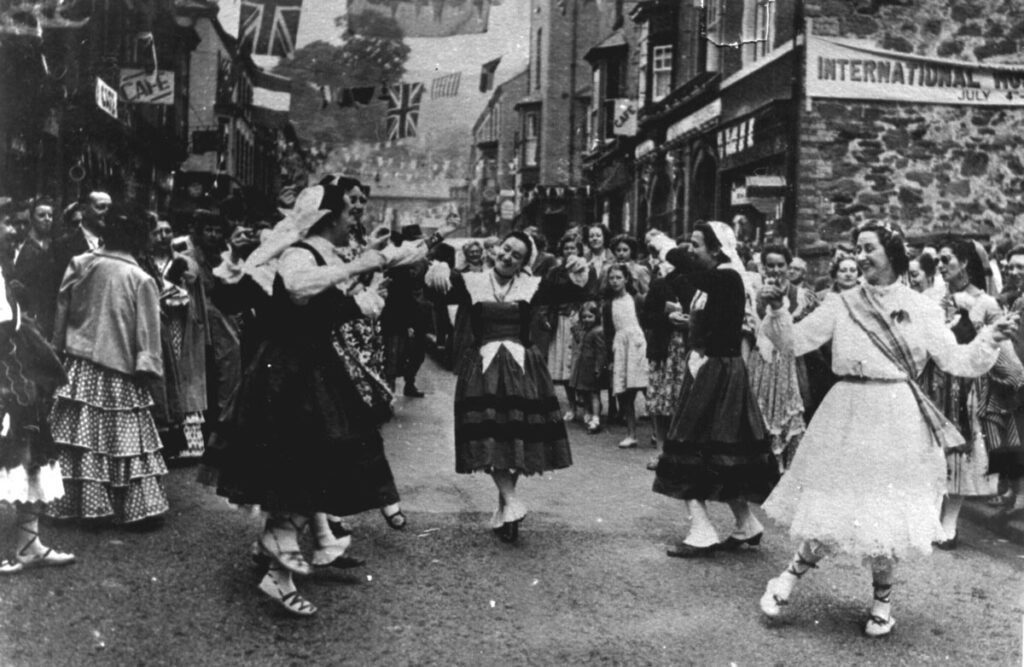
Dancers on Castle Street – Eisteddfod, early 1950’s


